 Chess
ChessGuide
Undetectable chess bot: what it really takes
Every chess bot on the internet calls itself undetectable. Almost none of them are, because being undetectable has nothing to do with hiding the software and everything to do with how the moves land on the board. Here is what the word actually requires in 2026.
Detection watches the board, not your PC
The most common misunderstanding about chess bots is that detection is a software problem, as if Chess.com scans your computer for forbidden programs. It does not need to. Fair-play systems work from the other side of the board: they analyze the moves you play, how long you take to play them, and how that pattern compares to millions of human games at your rating. Your play is the fingerprint. A bot that is invisible on your machine but plays like an engine is fully visible where it matters.
The patterns that give bots away
When an assisted account gets flagged, it is almost always one of the same few patterns:
- Accuracy that does not exist at your rating. A 1200 playing near-perfect chess game after game is not a hot streak. It is a statistical impossibility, and it is the first thing the system sees.
- Robotic timing. Engines answer in a steady rhythm. Humans blitz out the obvious recapture and sit for forty seconds when the position gets sharp. A bot that spends the same three seconds on every move has no heartbeat.
- Engine correlation. When your moves match a top engine line move after move, in game after game, the correlation itself is the evidence. No single move convicts you; the pattern does.
- Sudden rating climbs. Hundreds of points in a week draws a review on its own, even before anyone looks at the moves. We wrote more about the tools behind this in chess cheats for Chess.com, explained.
What "undetectable" actually requires
If detection is statistical, then staying undetected is statistical too. A bot that takes it seriously has to shape every one of those signals:
- Human move selection. Not the strongest move every time, but a believable move for the rating it plays at, including the occasional imperfection a real player would produce.
- Human timing. Fast moves in the opening, real thinking time in complex middlegames, speed-ups in time trouble. Timing should tell the same story a human clock would.
- Opening variety. Real players have a repertoire, not a single engine-approved line they repeat forever.
- A believable rating curve. Progress that looks like improvement, not like a switch being flipped.
This is the hard part of building a chess bot, and it is the part most free tools and browser extensions skip entirely. The engine is a solved problem. The disguise is not.
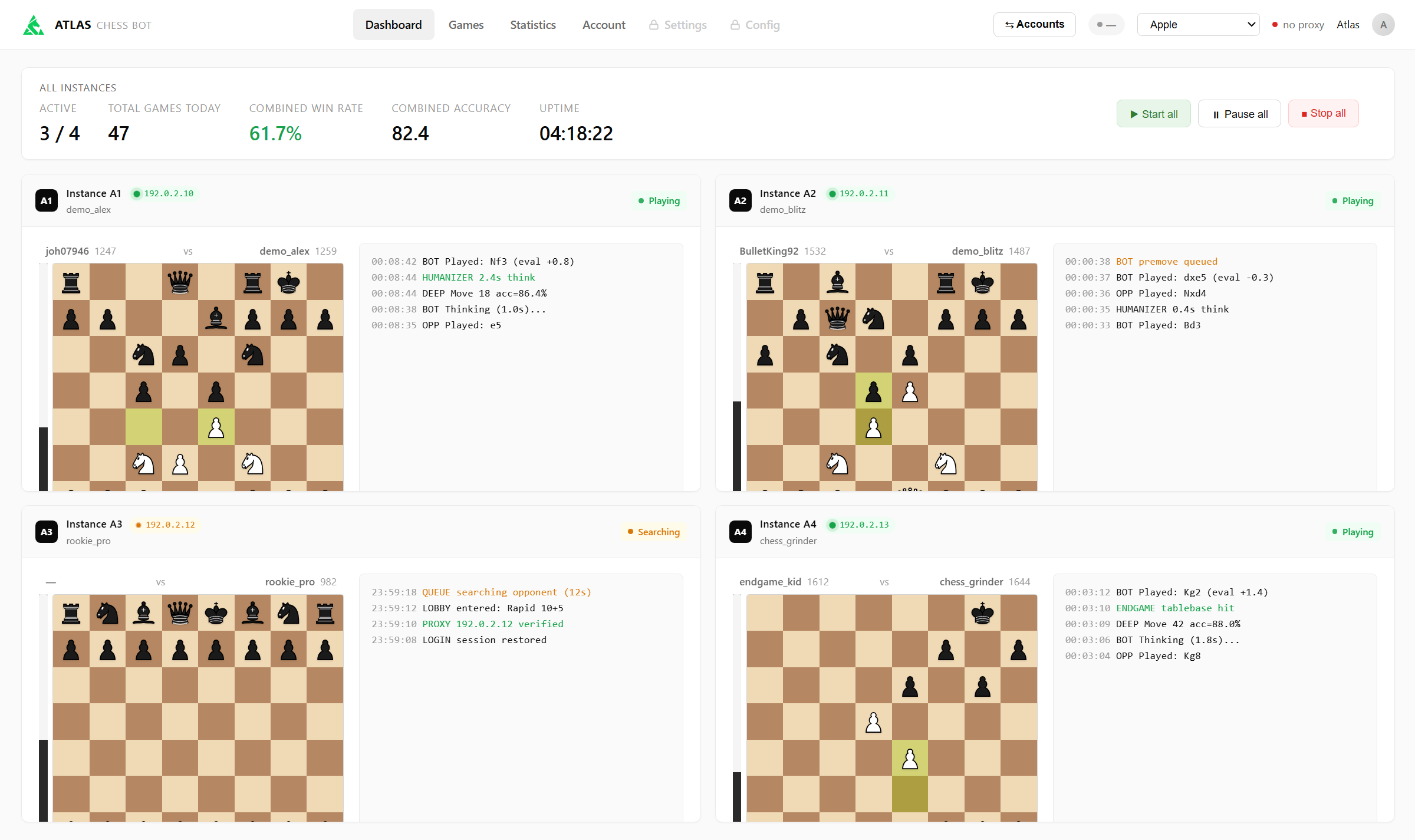
Where Chesscheats fits
Chesscheats is built disguise-first. It uses engine analysis for strength, but everything the account shows the outside world, move choice, timing, openings, pacing, is shaped to look like a human player of your level. Anti-ban protection is the core of the product, not a checkbox on a feature list. You can read exactly how it works and our honest answer to whether it is safe. No tool can make the risk zero, and anyone who promises that is lying to you; see our responsible use page.
Built to stay under the radar
Plans start at €10.00. Download the Chesscheats desktop app and play your first game today.
View plans